Martian dictionary
Stranger in a Strange LandThe Martian dictionary is a human-made record of Martian language, developed by Mike and members of the Nest through a process combining phonetic notation, mental rapport, recording, and painstaking transcription. Because Martians have no need for dictionaries, the project is not a translation of Martian into English: it seeks to create a dictionary in Martian, preserving the language’s definitions, idioms, and concepts in a form humans can learn to read. Its making becomes an organized communal undertaking, and ultimately a way to carry knowledge beyond the limits of Mike’s time and attention.
Purpose and Form
Miriam describes the project as unprecedented: the Martians do not need dictionaries, and a Martian-to-English dictionary would be impossible. The intended work is instead a dictionary in Martian. This distinction defines both its ambition and its difficulty. Rather than reduce Martian thought to English equivalents, the project aims to record the language in its own terms, including the concepts and idioms carried by its words.
The initial technical breakthrough is a phonetic script devised by Mike and Stinky. It has eighty-one characters, and an IBM typewriter is modified to use them in both upper and lower case. Miriam’s role is clerical, but the specialized machine changes the nature of her work: she learns to type Martian by touch. A manuscript in this script can be prepared and corrected, but the script itself is only one part of the problem. The material to be recorded must first be conveyed and retained accurately.
A Collective Method of Recording
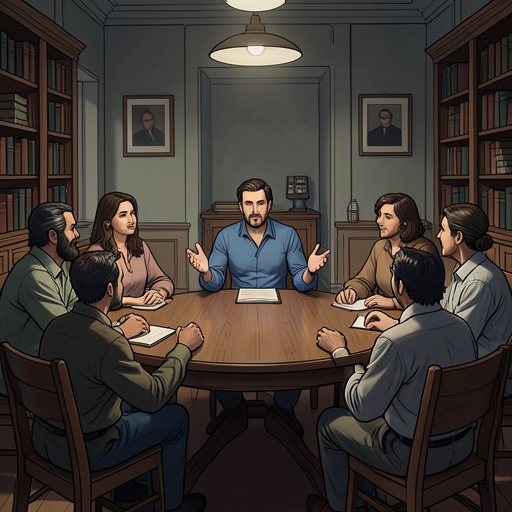
At first, the work proceeds through daily rapport between Mike and Stinky. Stinky receives material from Mike during these sessions, then dictates it onto tape. Other people trained in Martian phonetics make handwritten phonetic transcriptions from the recordings; Maryam types these on the special machine, and a master copy is corrected by hand, by Mike or Stinky. Mike is the preferred corrector, but his time is already heavily occupied.
The method changes when Mike recognizes that the existing schedule will not complete the work in time. Eight bedrooms are equipped with tape recorders, and selected members of the Nest take turns recording material. Mike puts each worker into a short trance and conveys language—definitions, idioms, and concepts—which the worker then dictates immediately, while recall is still fresh. The task requires more than membership or general familiarity with Martian: workers need a clear accent and the ability to enter rapport and accurately speak what they have received. Sam, for example, cannot be used because his Bronx-accented Martian speech would introduce errors.
This process makes the dictionary a distributed undertaking, but not an unselective one. Patty, Jill, Stinky, Maryam, and others participate; Becky Vesey and Alice Douglas are also among those able to dictate. Each person’s contribution depends on a particular combination of trained recall and usable pronunciation. The recordings preserve Mike’s input, while the transcriptions, special typing, and manual corrections turn it into a durable written resource.
Scale, Deadline, and Remaining Work
The project’s urgency is connected to Mike’s expectation that Maryam and Stinky will need to leave for a quiet place to finish the work. To prepare for that eventual departure, Mike begins producing months and years of tape in advance. The project also includes stacks of tapes of his lectures in Martian. Although listeners understood these lectures with his help when they heard them, they will need the dictionary to transcribe and publish them in print. The dictionary therefore serves as infrastructure for a much larger record of Martian teaching, not merely as a standalone reference book.
The workload expands sharply when Mike withdraws again and the group tries to complete as much recording as possible. Duke searches the city overnight for high-speed tape recorders; everyone capable of doing the work is brought in to receive Martian phonetic material and dictate it. Mike later describes the intensive session as having lasted about six weeks of subjective time, though only a short interval has passed outside it. He has conveyed only the primer knowledge he himself possesses, not the whole language. More advanced students, including Stinky, will have to return to Mars for a century to fill in what Mike never learned. The immediate recording push completes a substantial job, but it does not eliminate the need for extended study or make the project exhaustive.
Shared Labor and the Nest’s Economy
The dictionary is embedded in the Nest’s shared routines. When Ben visits, he finds money kept in bowls near the door, available to anyone going out and replenished when needed. The arrangement reflects the community’s effort to create an enclave of Martian-style sharing within a human economy. The dictionary likewise depends on members contributing their distinct abilities to a common undertaking rather than treating the work as a private possession or individual career.
That communal model is not presented as detached from material consequences. Stinky later observes that disciplined people could make money in markets, gambling, real estate, or other competitive settings in ways that would unsettle established property arrangements. Mike has them proceed cautiously, using dummy accounts and avoiding large gains. The dictionary’s knowledge work belongs to the same broader transformation: the Nest is developing skills and practices that challenge ordinary assumptions about property, expertise, and who controls valuable resources. The text does not say that the dictionary itself is used to make money; its significance lies in the shared labor and knowledge it makes possible.
Knowledge Beyond Mike
Mike’s teaching rests on his conviction that what he has learned should be available to others. He says that he brought his teaching into human society in the form of religion because it could not be taught in conventional schools and colleges, and that the discipline and knowledge were as available to others as they had been to him, raised in a Martian nest. The dictionary gives that transmission a written and collaborative form: it helps people learn Martian and makes recorded lectures accessible beyond the moment of direct contact with Mike.
The project’s limits are as important as its achievement. Mike can transmit only the knowledge he has acquired; the complete language remains beyond his own command, and further work will require prolonged learning by advanced students. Yet the shift from a few moments of rapport to banks of recorders, trained speakers, typed manuscripts, and corrected master copies shows how personal knowledge becomes collective practice. The Martian dictionary is both a linguistic instrument and a record of that change: a community learns not only what Mike can convey, but how to preserve and continue learning after he has moved on.